
Public Tours
As the Indian patients were leaving the Royal Pavilion in January 1916, the town of Brighton decided to open up the hospital to the general public for a limited time with paid admission as a form of raising money for the Mayor of Brighton’s War Charities.
Since the hospital had been off-limits to most civilians during the war, there was an intense curiosity to see how the Pavilion had been transferred into a hospital for the Indian patients. Opening for tours starting January 31, by February 9th, over 10,000 visitors had toured the Pavilion Indian hospital. [1]
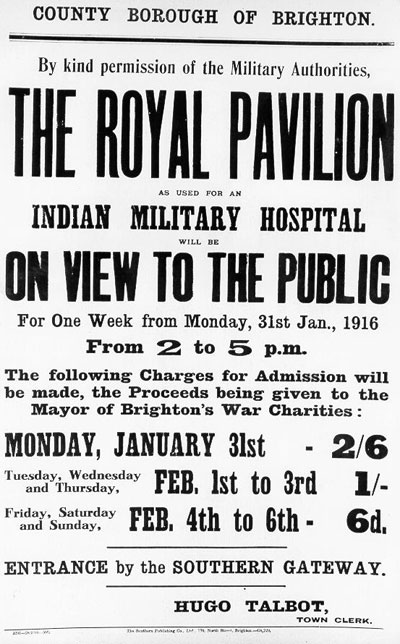
Brighton Gazette, Wed Feb 2, 1916
The magnificent State apartments, the smaller rooms, the Dome and the Corn Exchange are still to be seen as the gallant Eastern soldiers left them. The beds stand in white array, with the little table beside each, and all the facilities introduced for caste and ritual observances. Everything is brilliantly neat and clean. It is a pleasure to go through the wards, for the Indian atmosphere lingers, though the men have nearly all gone. A few Indians are still too ill to be moved, and the medical and nursing staffs have therefore not been quite disbanded. Several Indian orderlies and a number of British orderlies were about the place on Monday, and all of them were most courteous and helpful in directing visitors… The praying-tent [the Sikh Gurdwara], before the looped-up drapings of which the King and Queen and their entourage stood looking in at the wonderful scene of Eastern worship, has been removed, as there is no longer any need for it, the sacred accessories [the Guru Granth Sahib] having been taken away by the Indians; but the site is boldly marked and there is hardly a piece of ground in the British Isles which appeals more strangely to the historic imagination.
With the success of the viewing, Sir John Otter, the Mayor ended up diverting a substantial percentage of the funds raised towards commissioning his friend, local artist Charles Burleigh to produce a series of oil paintings depicting the Royal Pavilion as a Indian hospital. The funds did not go to the Mayor's War Charities as had been advertised. [2] The paintings produced by Charles Burleigh can be seen in the section The Arts - Paintings.
Footnotes
1. Joyce Collins, Dr Brightons Indian Patients December 1914 - January 1916 (Brighton Books, 1997) 28
2. Roy Pennington, "Royal Pavilion as Indian Military Hospital in WW1", The Argus, April 21, 2010
Copyright © 2012SikhMuseum.com. All Rights Reserved
Exhibits | About | Contact | Copyright
