
Battlefield to Hospital Bed
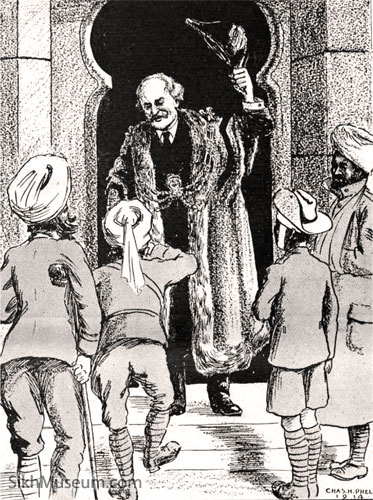
Pavilion Hospital. Brighton Society 1914', Dec. 3, 1914
If a soldier was injured in the no-mans land between the British and the Germans, he would likely have to wait until nightfall before being brought in for medical attention as rescue under fire in the daytime was very difficult.
The Regimental Medical Officers in the trenches after initially treating the wounded soldiers would have them sent to the Regimental Aid Posts at the rear. Here casualties would be sorted out and field ambulances which were mostly horse driven carts with some motor driven ambulances would take the wounded to an Advanced Dressing Station which were typically two to three miles away. [1]
From the Advanced Dressing Stations the wounded soldiers would be taken to one of six hospital trains which were fully equipped hospitals on wheels with facilities for operations and treatment. These medical trains could typically carry up to 400 patients and would make the journey to the French coastal ports of Boulogne or Le Havre which was 200 miles further. [2] This train could take up to three days and some of the more seriously wounded died during this journey.
From the coastal ports at Boulogne and Le Havre the Indian soldiers were transferred to specially equipped hospital ships for the journey across the English Channel to England.
Once in England the wounded soldiers would be taken by train to Brighton. During the war 233 London, Brighton and South Coast Railway ambulance trains would carry over 30,070 wounded soldiers to Brighton. [3]
Once the hospitals in Brighton were ready to receive the wounded Indian soldiers, many of them that had been wounded earlier and had been taken to Southampton and the nearby Netley hospital were also now transferred to Brighton. [4]
A number of motor ambulances were set up under the command of Major Brailey to take the wounded Indian soldiers from the Brighton train station where they would arrive to their hospital beds at the Royal Pavilion, Kitchener or the York Place hospitals in town. On several occasions as many as 200 wounded Indian soldiers would be in their beds in little over an hour after their arrival at the Brighton Railway Station. [5]
The very first small contingent on wounded Indian soldiers arrived on Saturday December 5, 1914 [6] and were taken to the Royal Pavilion where they were placed in the hospital wards set up in the Music Room and the North Drawing Room.
The first large contingent of Indian soldiers would arrive nine days later on Monday December 14, 1914. [7] There was much excitement in Brighton and a large crowd gathered to cheer the arriving Indian soldiers including the Mayor and other town officials. There were two trains, the first with 112 patients (100 of which were serious stretcher cases unable to walk) and 233 Indian soldiers in the second train. Of this first large contingent of Indian soldiers, 200 were taken to the Royal Pavilion hospital and 145 were sent to the York Place hospital. [8]
Even though it was a cold and rainy day, the crowds nevertheless cheered the arriving heroes from the Front.
Brighton Gazette December 16, 1914
‘At last the wounded Indians are duly installed at Brighton. They arrived under rather mournful conditions. A drab day, rainstorms, and a fierce sea running in the Channel, mud-laden streets, and a vista of dripping umbrellas and mackintoshes. That was the first impression the warriors got of Brighton, and it was rather chilling. But crowds assembled to voice public welcome, and the reception undoubtedly cheered the brave fellows. The hundred stretcher cases in the first train that reached the terminus on Monday afternoon constituted perhaps the most distressing of the many pathetic sights seen on similar occasions during the past four months. Something akin to a feeling of awe was created by the silence with which the work of bringing them out of the train and placing them in the motor ambulances was carried on.
Footnotes
1. Joyce Collins, Dr Brightons Indian Patients December 1914 - January 1916 (Brighton Books, 1997) 15
2. Bert Williams, Military Hospitals in Brighton & Hove, www.mybrightonandhove.org.uk
3. Kim Leslie and Brian Short, Brian, ed. An Historical Atlas of Sussex (Chichester: Phillimore, 1999) 117
4. Joyce Collins, Dr Brightons Indian Patients December 1914 - January 1916 (Brighton Books, 1997) 7
5. A Short History In English, Gurmukhi & Urdu of the Royal Pavilion Brighton and a Description of it as A Hospital for Indian Soldiers (Corporation of Brighton, 1915) 9
6. Joyce Collins, Dr Brightons Indian Patients December 1914 - January 1916 (Brighton Books, 1997) 9
7. Ibid.
8. Ibid. 9, 18
Copyright © 2012SikhMuseum.com. All Rights Reserved
Exhibits | About | Contact | Copyright
