
Hospital Preparations in Brighton
On the southern coast of England, Brighton appeared to be a natural choice in terms of geographical proximity to the battlefields of France for setting up proper hospital facilities for Indian soldiers in England. So close that in June 1916 the sound of guns firing at the Battle of Somme could be heard on the cricket field at Brighton College. [1]
Lord Kitchener the Secretary of State for War appointed Sir Walter Lawrence as his Commissioner in charge of the Welfare of Indian Troops to quickly find arrangements for the ever growing number of Indian wounded soldiers. [2]
Sir Walter Lawrence accompanied by Major P.S. Lelean of the Royal Army Medical Corps who had experience in India visited Brighton on Saturday November 21, 1914. [3] The Mayor of Brighton Alderman Otter and the Corporation of Brighton agreed to make three facilities available to the Army to be converted into hospitals. These would include the York Place School, the Royal Pavilion Complex and the Brighton Workhouse. Returning to London that same day, Sir Walter Lawrence telegraphed His Majesty that the Royal Pavilion complex had been secured as an Indian hospital. The King was very pleased with the news. [4]
For further details on some of the politics behind the decision to choose the Royal Pavilion see Analysis - Selection of the Royal Pavilion
The work of converting the buildings was led by Major Lelean.
The York Place School in Brighton was rapidly converted into a 550 bed military hospital. Classrooms were filled with beds and the gymnasium transformed into a 60 bed ward. [5]
The Royal Pavilion Complex and the Brighton Workhouse would next be converted into large facility hospitals in a rapid time frame due to the urgency of finding space for Indian wounded soldiers. Work progressed immediately on the conversions with many challenges to overcome. In fact the first small contingent of wounded Indian soldiers would arrive in Brighton a mere 13 days later in mid December 1914. [6]
Royal Pavilion Complex Becomes a Hospital
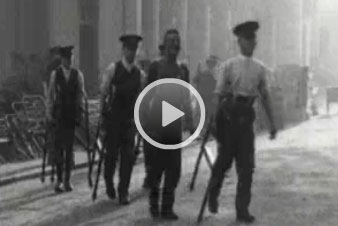
hospital bed frames for the conversion of the Royal Pavilion.
From a crowded museum and public space, the Royal Pavilion, the Dome and the Corn Exchange buildings were now transferred into hospital wards.
In the Royal Pavilion, the Banqueting Room, the Music Room, the South Drawing Room and the Saloon were all converted to hospital wards. The rooms upstairs were converted to semi-private hospital rooms for ranking Indian officers. [7] There was no running water in the palace, so hot and cold water plumbing had to be laid out in every ward, theatre and bath and sanitary arrangements made by linking up the sanitation system with that of the town. [8]
Ventilation in the Royal Pavilion and the Dome was found to be woefully inadequate and radical improvements were made to the structures to improve the flow of air in the buildings. Two operating theatres, one in the Dome and another in the Royal Pavilion were set up. [9]
The Dome, a theater had 1,500 seats clamped to it’s tiers that had to be removed and the entire floor was covered with khaki coloured linoleum. A detachment of troops from the nearby Sussex Yeomanry were used to assemble and set up all of the hospital beds. [10]
Major Lelean now having completed the initial set up of the various wards with hospital beds by the end of November 1914 sent a set of photographs to the War Office, ‘showing the Dome as a completed Hospital with radial beds around a center embedded in tropical foliage’. The photographs were delivered to Lord Kitchener who took them straight to King George. Both considered the arrangements made as excellent. [11]
In total the Royal Pavilion, Dome and Corn Exchange housed a total of 724 beds. [12]
Brighton Workhouse Becomes the Kitchener Hospital
Workhouses were a type of social welfare housing prevalent in 19th and early 20th century England. Here the poor, seniors, orphans, unmarried mothers and those with physical or mental challenges would live and work. In order to deter able-bodied paupers seeking to take advantage of community charity, conditions in workhouses were intentionally harsh. Families would be separated as married men and women were forced to live separately and their children taken away from them with limited contact and raised by the institution. Although inmates were free to leave at will, those who stayed because they had no other option faced a life of often menial work, monotonous food and communal dormitories. The Brighton Workhouse was completed in 1867 and initially housed 861 inmates. [13]
The Brighton Workhouse was chosen as a candidate for conversion into what would be the largest Indian Soldiers hospital in England.
The Workhouses existing 1,050 inmates were evacuated to large homes in Brighton and Hove and other facilities, much to the inconvenience of their new hosts who were less than thrilled to have the sick and infirm inmates as guests. [14]
After extensive conversion the workhouse was converted into a 1,700 bed hospital with the capacity to accommodate 1,000 more patients in tents or huts on the adjacent racecourse if necessary. The Workhouse was now renamed the Kitchener General Indian Hospital in honor of Lord Kitchener who had previously been commander of the Army in India from 1902 to 1911 prior to his current appointment as Secretary of State for War in 1914. [15]
Indian Army veteran Brevet-Colonel Sir Bruce Seton, Bt. who had previously been the Honorary Surgeon to the Viceroy and Deputy Director-General of the Indian Medical Service was appointed the Commanding Officer of the new Kitchener hospital. [16]
Footnotes
1. Martin Jones, Brighton College 1845–1995. (Chichester: Phillimore, 1995) 174
2. A Short History In English, Gurmukhi & Urdu of the Royal Pavilion Brighton and a Description of it as A Hospital for Indian Soldiers (Corporation of Brighton, 1915) 4
3. Joyce Collins, Dr Brightons Indian Patients December 1914 - January 1916 (Brighton Books, 1997) 6
4. Ibid.
5. http://www.chailey1914-1918.net/for_king_and_empire.html
6. Joyce Collins, Dr Brightons Indian Patients December 1914 - January 1916 (Brighton Books, 1997) 6
7. Ibid. 7
8. A Short History In English, Gurmukhi & Urdu of the Royal Pavilion Brighton and a Description of it as A Hospital for Indian Soldiers (Corporation of Brighton, 1915) 5
9. Ibid. 9
10. Joyce Collins, Dr Brightons Indian Patients December 1914 - January 1916 (Brighton Books, 1997) 7
11. Ibid.
12. Royal Pavilion as an Indian Military Hospital, www.brighton-hove-rpml.org.uk
13. Tim Carder, Brighton General Hospital, www.mybrightonandhove.org.uk
14. Ibid.
15. The Kitchener Indian Hospital, (The British Medical Journal, April 3, 1915) 612
16. Ibid.
Copyright © 2012SikhMuseum.com. All Rights Reserved
Exhibits | About | Contact | Copyright
